
What makes a brand recognized, and what makes it chosen.

A Brand System Is a Set of Decisions Already Made
Most of what gets delivered as a brand system is an inventory. Logo variants, a palette, type scales, photography direction, a page of tone-of-voice adjectives. All of it useful, none of it a system, and the difference only becomes visible at the moment a situation arrives that the inventory did not anticipate.

Brand Architecture Is a Decision About Where Risk Travels
Brand architecture is conventionally presented as a taxonomy of naming structures, which makes it look like a question of nomenclature and hierarchy charts. It is not. It is a single decision, made once and difficult to reverse, about where credibility is allowed to accumulate and where a failure is allowed to spread.

Refusal Is Structural, Not Behavioral
The advice to walk away from work that is not a fit is correct and almost entirely unusable. It asks for the most pressure-resistant behavior available, at the moment of maximum pressure, from whoever is least able to supply it. Refusal that holds is not a decision made in the room. It is a set of criteria decided long before the room.

Operational Structure Cannot Enforce Itself
I have installed operational structure that worked, and then watched it come apart. The design was not what failed. A structure that routes decisions has no authority of its own, so it is held in place either by a mandate or by the presence of the person who built it. Remove that person and it reverts, which means the dependency was never removed. It was relocated.

Where the Work Converges
Strategy, design, culture, and execution are not four services. They are one competence, and the work only holds when they are carried in the same mind at once. Separate them and each fails in its own direction. Held together, they produce the only outcome that matters: a brand that holds its value as it scales.

When Luxury Language Stops Working
At the very top of the market, luxury signals do not persuade. The buyer has seen all of them, and has learned to read through them in seconds. What moves the decision is something quieter and much harder to manufacture: the evidence of a single mind behind every choice.

The Aesthetic Is No Longer the Proof
AI has solved the hardest surface problem in branding: making something look right. What it cannot do is tell you what the brand should believe, who it should refuse, or why it should exist. That question was always the real work. Now there is no way to avoid it.

Why Belonging Has Become a Luxury Commodity
Access says: you are permitted to be here. Belonging says: you are recognized here. Your presence makes sense here. The values of this place reflect something true about who you are. Access is a gate. Belonging is a mirror. The brands confusing the two are investing in admission while the consumer's deeper need goes unaddressed.

The Future of Premium Brands Is Emotional Safety
There is a specific feeling that the best premium brands produce. It is not excitement. Not the elevated pulse of encountering something beautiful or rare. The feeling is closer to relief. The relief of being in contact with something that knows exactly what it is — that delivers precisely what it implied it would, with a consistency so reliable it stops being noticed and starts being trusted.

Why People No Longer Buy Luxury for Status Alone
Status still works. What has changed is the sophistication of the signal. The luxury consumer who once bought access to a category now wants to demonstrate mastery of it. The one who once wanted to be seen wearing the brand now wants to feel that the brand sees them. This is not a values revolution. It is a perceptual evolution.

Quiet Luxury Is Operational, Not Visual
Quiet luxury is not a visual style. It is a quality of experience. The restraint associated with it is a symptom of something operational, not a cause, and not a replicable aesthetic shortcut. A brand does not become quiet luxury by removing its logo. It becomes quiet luxury by building the operational precision that makes demonstration unnecessary.

The Shift From Visual Identity to Identity Systems
Visual identity defines how a brand looks. An identity system defines how a brand behaves. The shift between the two is not an evolution in design sophistication — it is a shift in what the work is fundamentally for. From appearance to behavior. From form to function. From artifact to architecture.

Creative Direction Without Operational Alignment Is Decoration
Creative direction without operational alignment produces beautiful work the organization cannot sustain. The concept is precise. The vision is clear. And then it meets the organization and fractures. Because vision without system is not strategy. It is taste. And taste, however refined, does not scale.
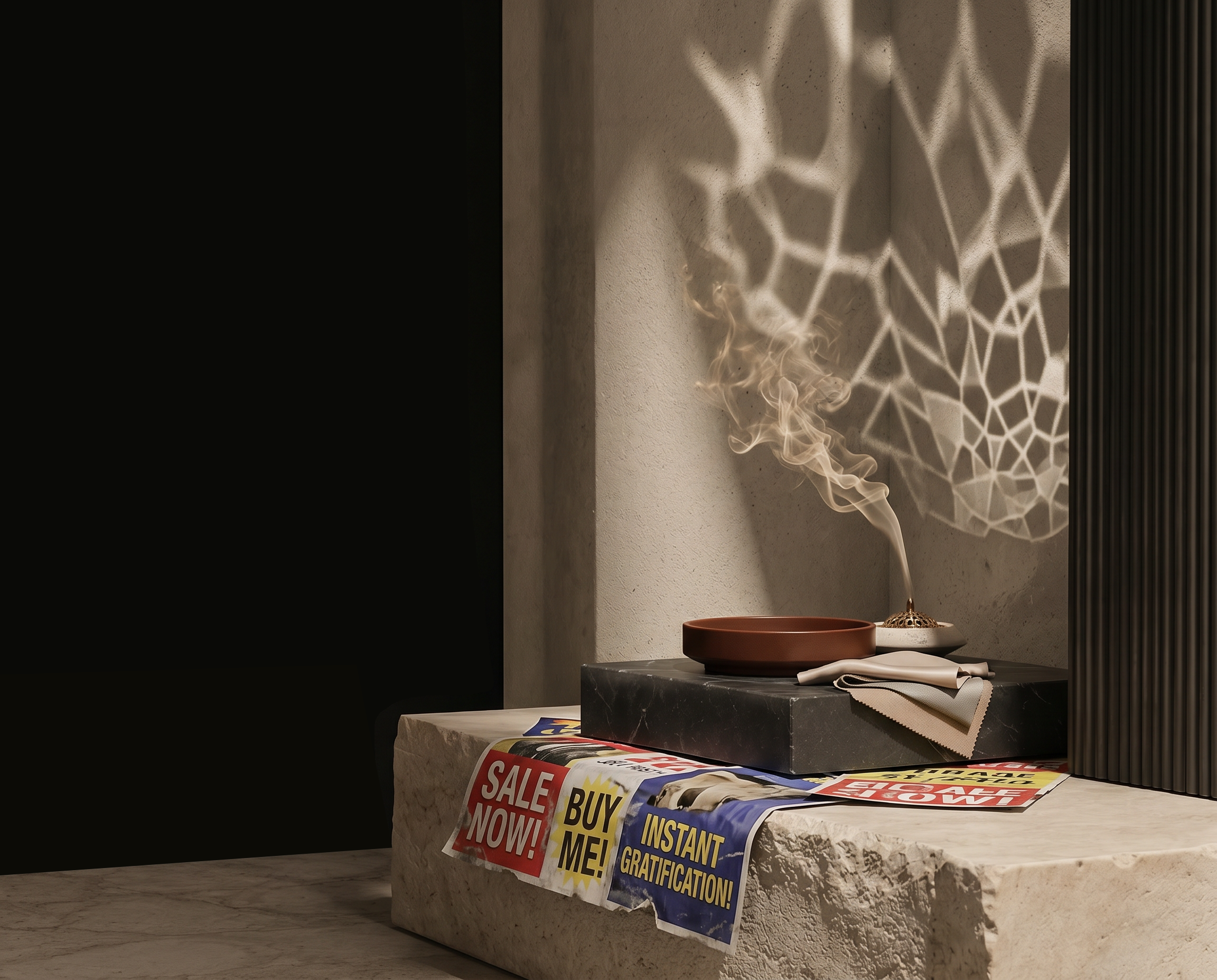
Why Atmosphere Is Becoming More Valuable Than Advertising
Atmosphere is not ambiance. It is a precision instrument for building brand perception that no media buy can replicate. The brands that understand this are operating at a different level entirely.

The Invisible Infrastructure Behind Premium Brands
What separates a premium brand from an expensive-looking one is not visible. It is the infrastructure underneath: the decisions, frameworks, and operational logic that most founders never build because no one told them it existed.

Design Gives Form. Structure Allows Performance.
The industry celebrates design as the primary indicator of brand quality. But design without structure is decoration with a deadline. Form is visible. Structure is operational. Confusing the two is why so many well-designed brands still underperform.

Why Most Luxury Brands Don't Have a Design Problem
The real problem isn't design, it's the absence of conceptual control over perception. The piece must surface a hidden structural truth that sophisticated founders recognize immediately.
Receive Field Notes
What makes a brand recognized, and what makes it chosen.
One considered note per week. Unsubscribe anytime