
The THESIS
A brand that only works when the founder is in the room is not yet an asset.
It is still dependent on one person’s judgment. The standard holds because the founder is holding it.
The work is to build the structure that holds the standard when the founder is not there.
The LLB System™
Founder instinct → Authored position → Operating system → Perception that travels.
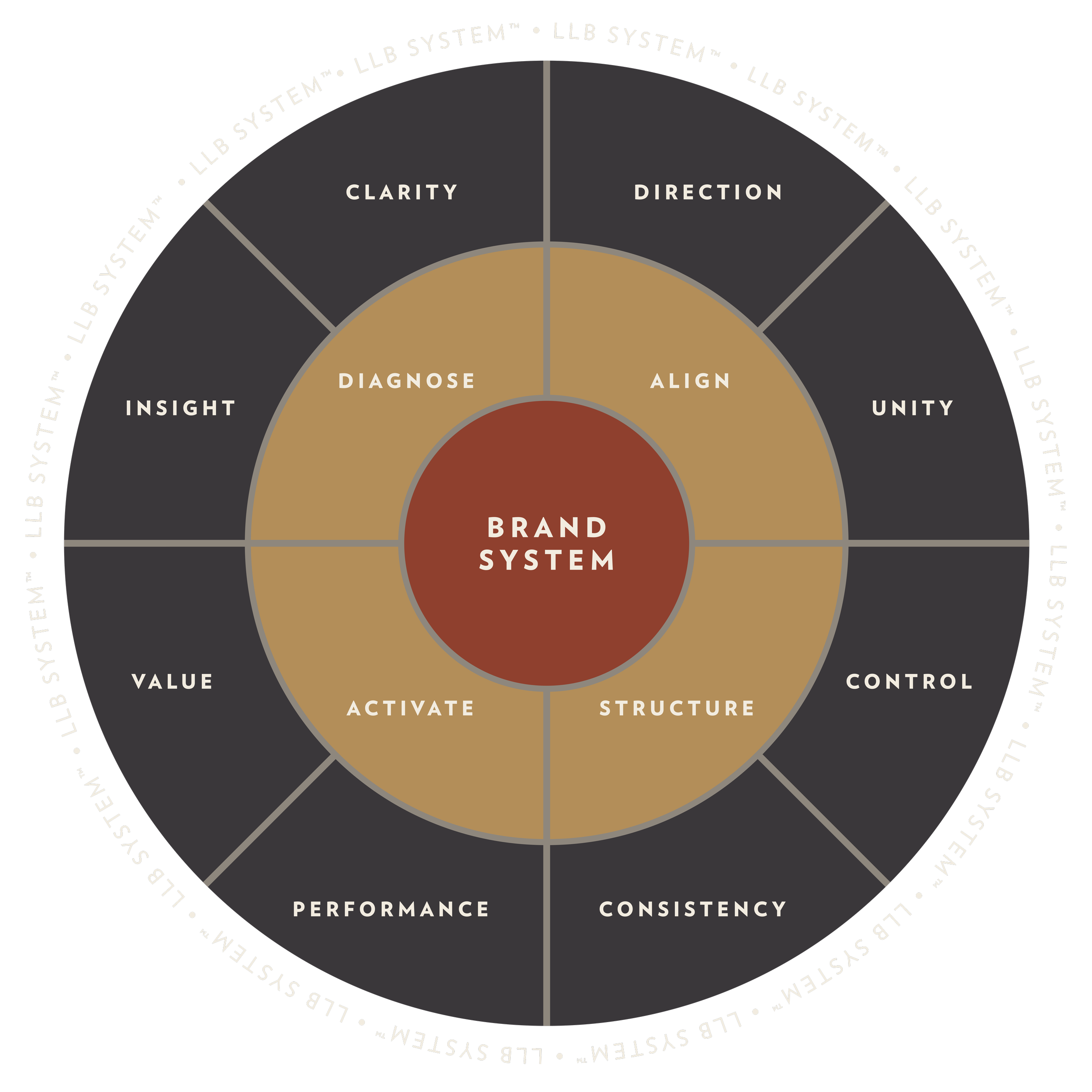
Diagnose. Align. Structure. Activate.
Not a process. An operating architecture the brand keeps building on long after I have gone.
Diagnose
Find the structural cause before the brief is written.
What is read — The belief system, the commercial model, positioning, leadership dependency, and the distance between what the brand claims, how it behaves, and what the market actually receives.
What an audit cannot measure — and this is the part that decides everything after it: the character of the organization, and what the brand needs one person present to hold.
Where nothing has launched — the same reading runs forward instead of backward. Not what broke, but what will have to hold.
What it produces — The fracture named, the most dangerous fragility, and the order in which things have to be resolved. It does not build the answer.
Align
Positioning, narrative and culture have to agree before anything is built.
The core claim is set here — the one thing the brand says that is true, defensible, and refusable. Everything downstream follows from it.
What it prevents — A brand that contradicts itself is not misunderstood. It simply does not form an impression, and an impression that never forms cannot be returned to.
Why it is invisible while it is happening — Misalignment surfaces much later, as everything that feels off and nobody can name.
structurE
The architecture that lets coherence survive people, formats and time.
What gets codified — How identity, environment and communication relate, and the standards that govern how the brand behaves across teams, formats and touchpoints.
What it converts — The founder’s taste becomes a system, which is what makes it handable to a successor, an incoming agency, or a second property without thinning.
Why it is not consistency for its own sake — A brand that is right most of the time is not recognized, it is remembered inconsistently. Structure turns being right into being counted on.
Activate
The system starts producing decisions rather than documentation.
Where it lands — The experience, the commercial motion, and the approval standard a team checks its own work against before anything ships.
What changes for the founder — They stop being the point of approval. The architecture becomes the standard.
Why the hundredth contact matters more than the first — Devotion is not built in the strategy. It is built at the hundredth point of contact that behaves exactly like the first.
What the four stages produce
Each stage produces two outcomes. None of the eight is a promise. Each describes a structural state that comes to exist.
Diagnose · Clarity. The gap between what the brand claims, how it behaves, and what the market actually receives, stated in one place. Most brands have never seen the three side by side.
Diagnose · Insight. The structural cause rather than the symptom, including what an audit cannot measure: the character of the organization, and what the brand still needs one person present to hold.
Align · Direction. The core claim, set. The one thing the brand says that is true, defensible, and refusable. Everything downstream follows from it, which is why it is decided once.
Align · Unity. Positioning, narrative and culture saying the same thing. A brand that contradicts itself is not misunderstood. It simply never forms an impression.
Structure · Consistency. The standard holds across teams, formats and time. Being right most of the time is not recognition, it is being remembered inconsistently.
Structure · Control. Authorship over execution without supervising it. The founder's taste becomes a system, which is what makes it handable to a successor, an incoming agency, or a second property without thinning.
Activate · Performance. The system produces decisions rather than documentation. The team checks its own work against the architecture before anything ships.
Activate · Value. What the business is worth stops depending on who is in the room. A brand that only works when the founder is there is not yet an asset.
WHERE IT APPLIES
The reading runs in two directions
Forward where nothing is built yet, and backward where a structure has stopped holding. Which of the two applies is established before anything is proposed.
It reads two kinds of asset, and this is the distinction that changes the work.
Two assets
The brand. A company, property, group or product line that has to outlive the founder. The work removes the brand’s dependency on the person.
The principal. A person whose own name, authority or practice has become the asset. The work gives that authority a structure that operates beyond their bandwidth.
The second is not personal branding. Personal branding builds visibility for someone who wants to be known. This is architecture for authority that already exists and has no structure underneath it.
six instruments carry the weight of the System. Each answers one question a brand has to resolve before it can move.
THE INSTRUMENTS
1 · The entry diagnostic
LLB Structural Reading where nothing is built yet. LLB Brand Architecture Audit where the brand already exists. One engagement under two names, same format, same scope, same three weeks. What changes is what it reads, never what you receive.
One written diagnosis, and one readout with the person who decides.
It says what is wrong, why it matters, and what the architecture has to resolve. It does not propose the solution.
It is the only door in. Nothing is designed before it is understood.
2 · Brand as operating system
A brand is not an aesthetic asset. It is a system with seven elements: epic narrative, creed, icons, rituals, lexicon, nonbelievers, leader.
One absent means structurally compromised, not partially complete.
The instrument maps which are present, which are absent, and which are compromised. That map is the brief everything else is built from.
3 · The authority triangle
A brand’s authority rests on three surfaces at once: speech, deliverables, image.
All three hold at the same level, or one falling pulls the others down.
It locates where the authority is strong, where it is thin, and where the distance between what the brand says and what it delivers is eroding the position.
4 · The coherence test
The single gate before anything ships. Not whether it is well made, on trend, or likely to perform.
The question is whether it is coherent with what this brand actually is.
Work that fails it does not ship, regardless of its quality. This is what turns a brand system from a document into a discipline a team can enforce.
5 · The invariant set
Two lists: what may change as the brand grows, and what may not change without a deliberate decision.
A brand cannot govern what has never been named as ungovernable. Every erosion enters as a reasonable-looking decision about something nobody had declared fixed.
It gives the brand an inspectable object: test whether anything on the protected list moved, and whether the movement was decided or merely happened.
Written and installed through LLB Governance, after the build.
6 · Cultural Latitude
A brand arriving somewhere new has to be adjusted. That was never the question. The question is how far it can move before the thing people were meant to recognize is no longer there.
A brand has to arrive, be received, and be desired. Adjust too little and it arrives without ever being received. Adjust too far and there is nothing left to desire.
Latitude is the distance between those two, and it belongs to the crossing rather than to the brand. The same brand holds a different one in every market, because every market already believes something about where that brand came from.
The instrument takes the measure before the position is written, then governs everything that moves inside it. What is adjusted, how far it travels, and what stays untouched so the brand is still itself when it arrives.
WHAT CHANGES
| Before | After |
|---|---|
| The standard lives in one person’s judgment | The standard lives in an architecture that person authored |
| Quality is enforced by presence | Quality is enforced by structure |
| Every decision escalates | Decisions resolve at the level where they occur |
| Consistency is supervised | Consistency is designed |
| Growth dilutes the brand | Growth happens without thinning the brand |
| The founder is the asset | The founder is the author of the asset |
How the system leaves
The architecture is built to make my exit a real option, not an inevitability.
Complete handover is the default. A brand that still needs me after the build is a brand that was not finished.
LLB Direction decides what is new, for conditions the architecture was not built to anticipate.
LLB Governance holds what is already true, installed inside the company as an AI agent trained on the architecture I built.
The founder remains the author of the standard. The brand stops requiring their presence to obey it.