
Architect the system. Design the perception.
I did not come to make beautiful things. I came to decide what a person meets when they walk into what I built.
That is why strategy and creative expression are not separate stages in my work. Position, identity, communication and the logic that connects them work as one system. I do not consult in the abstract and hand execution to someone else: I develop the assets that take the strategy into the world.
The goal is a brand that keeps its character at every point of contact and every stage of growth, and carries its own meaning instead of depending more on the person who created it.
Strategy with depth, so the brand performs. Design with perception, so it is felt. Detail with devotion, so the feeling stays.
THE LLB SYSTEM™
Founder instinct → Authored position → Operating system → Perception that travels
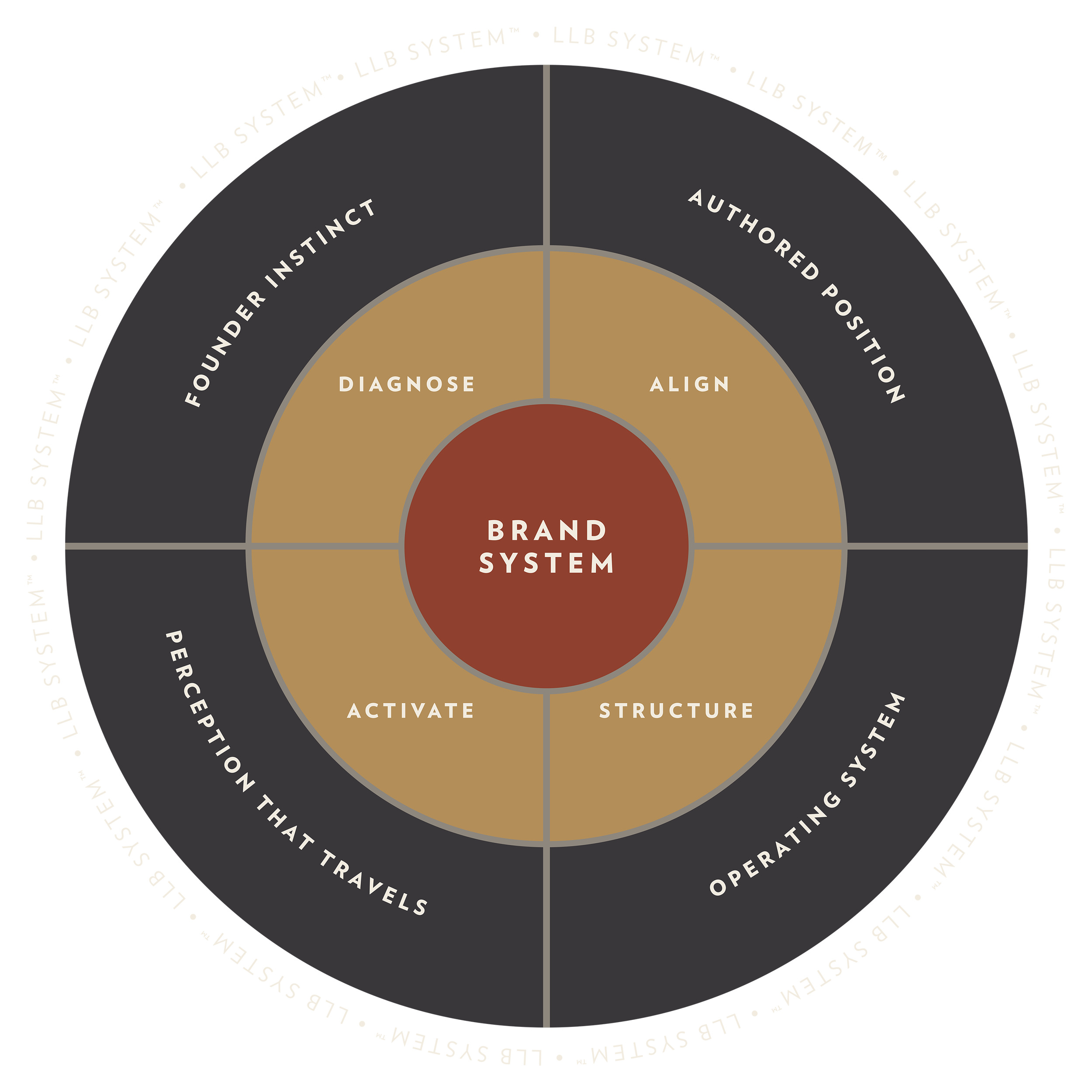
Diagnose
What does the brand already have, and what keeps it from showing?
The real problem is named before anything is designed.
Align
What should the brand mean, say and refuse?
Position, narrative and the culture the team carries move in one direction.
structure
How does the standard become something people can see,
hear and walk into?
Identity and experience express one brand, across every team, agency and place that carries it.
Activate
How does the brand enter the world, and stay itself?
The brand keeps its standard, and you lead it instead of holding it up.
WHAT THE FOUR STAGES PRODUCE
-
Brand Diagnosis, in five reads. One written reading, delivered in person, naming what the brand has and what has to be built first.
X-Ray. What the organisation believes, and where its behaviour contradicts it.
Business Model Reading. How the business makes money, and whether that carries the position.
Value Logic. Whether the brand competes and justifies, or grows by being desired, and where it mixes the two.
Leader Readiness. Whether the founder can carry what is being built.
Journey Analysis. The distance between what the brand promises and what the client lives.
-
Brand Creed. What the brand believes, written so a team can act on it without asking.
Positioning. What the brand is, who it is for, and what it refuses.
Narrative. Where the brand comes from and why it matters, told the same way by everyone who tells it.
Lexicon. The words the brand owns, up to the few its clients begin to use on their own.
Brand Hierarchy. How a parent brand and its properties, offers or sub-brands relate, so each moves in its own register and still reads as one house.
Brand Detox. What the brand carries that dilutes it, or that was never its own, found and let go, so what remains is unmistakably yours.
Stretch Test. Before a new location, product or audience: how far the brand can travel and still be recognized as itself.
Employee Value Proposition. Why the right people join, stay, and carry the brand when no one is checking.
-
Naming. A name that carries the position before anything else is said.
Brand Persona. How the brand behaves, not only how it sounds.
Verbal Identity. Tone, language and the lines the brand repeats, written so anyone can speak it.
Tagline. One line the brand can stand behind for years.
Visual Identity. Mark, typography, colour and image, made from the strategy rather than laid on top of it.
Design System Principles. The rules that let other hands design for the brand and still get it right.
Packaging. The object the client holds, designed as part of the brand.
Image Direction. What the brand photographs, how, and what it never shows.
Brandbook, with Brand Constants. The whole system in one place, including what may never change without a deliberate decision.
Experience Brief. What the architect, the interior designer and the operator receive before the first drawing: what the place must make a guest feel.
Journey Design. Every point where a client meets the brand, in the order they meet it.
Signature Moments & Rituals. The few moments a client remembers and retells, designed on purpose.
Sensory Identity. The welcome, the music, the scent and the light, decided rather than left to whoever is on shift.
Content & Social Playbook. What the brand publishes, where, and in what voice, so the feed and the room say the same thing.
-
Brand Launch. The brand introduced in an order people can follow, inside the company first, then outside.
Communication Campaigns. Campaigns built from the position, so each one adds to the brand instead of borrowing from it.
Commercial Calendar. A year of launches, seasons and offers planned around the brand, not around the next promotion.
Founder Authority Architecture. Personal branding for the founder whose own name is part of the asset: what they say, what they deliver and how they appear, held at the same level.
Brand Onboarding. How a new person learns the brand in their first weeks, before they have to improvise it.
Training & Mentoring. Sessions with your team, and one-to-one mentoring for you, so everyone who carries the brand can read it and decide with it, and the standard no longer depends on one person's approval.
Team Structure. The roles, rituals and decision rights that keep the brand coherent as the team grows.
LLB Governance. The standard installed inside the company after the build, as an AI agent trained on the architecture, so the team checks its own work before anything ships.
LLB Advisory. Senior counsel from outside, when a decision is bigger than the system in place.
The diagnosis decides what gets built, and what does not.
What the diagnosis usually finds
A brand that runs through one person rarely has a design problem. It has a structural one, and it usually reaches further than the brand. Everything routes through that person, including the way the business earns: the revenue does not scale past that person's hours, the price reflects their time rather than the value of the system, and what presents as a portfolio of offers is often a collection of things one person can personally do.
You cannot decorate your way out of a structural dependency, and you cannot position your way out of a business model that only works while the founder is personally in it.
WHAT YOU BUY
A brand system is not an aesthetic asset.
It is an economic one, and it works in one direction.
Structure creates coherence.
Coherence creates perception.
Perception creates confidence.
Confidence creates decision.
Decision creates value.
A business can outgrow its brand by an order of magnitude and keep operating.
What it cannot do is get paid at the level it has already reached.
WHERE THE BRAND BECOMES A PLACE
When a brand lives in a room, a restaurant, a residence, a hotel or a spa, I begin before the first drawing, so the architect, the designer and the operator build from the same intention. Atmosphere is not the finish. It is part of the position: what the guest remembers, what the team repeats on every shift, and what stays after the bill is paid.
TWO WAYS TO WORK WITH ME
Inside your team, or on a defined project.
Inside your team
Senior brand judgment inside your leadership, through a launch, an expansion or a change of direction. By direct hire, or by contract as LLB Direction.
On a defined project
A specific build, from positioning and identity to experience and launch, scoped from what the diagnosis finds.